


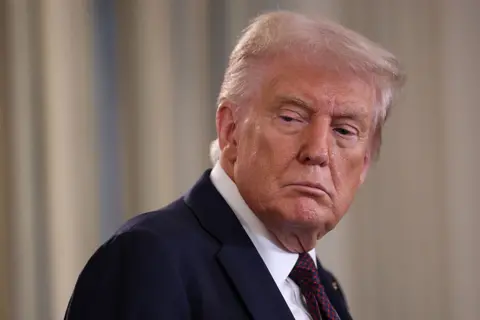
The judicial body begins its new session on Monday with a docket already packed with likely significant legal matters that may define the limits of Donald Trump's presidential authority – and the possibility of more matters to come.
Over the recent period following Trump returned to the executive branch, he has pushed the boundaries of presidential authority, independently implementing fresh initiatives, reducing public funds and personnel, and attempting to place formerly independent agencies more directly under his control.
Constitutional Disputes Over National Guard Deployment
A recent emerging judicial dispute stems from the president's moves to seize authority over local military forces and send them in cities where he alleges there is social turmoil and escalating criminal activity – over the objection of local and state officials.
Across Oregon, a federal judge has delivered rulings halting the President's mobilization of troops to the city. An higher court is scheduled to review the move in the near future.
"Ours is a land of legal principles, instead of army control," Judge the court official, whom Trump appointed to the court in his previous administration, wrote in her latest statement.
"Defendants have offered a variety of arguments that, if accepted, threaten weakening the line between civilian and defense government authority – to the detriment of this republic."
Shadow Docket May Shape Military Power
Once the appellate court has its say, the Supreme Court might step in via its so-called "expedited process", handing down a decision that could restrict Trump's authority to employ the troops on US soil – conversely provide him a free hand, for now temporarily.
Such proceedings have become a increasingly common occurrence recently, as a greater number of the judicial panel, in response to urgent requests from the executive branch, has largely allowed the administration's actions to proceed while legal challenges unfold.
"A continuous conflict between the Supreme Court and the lower federal courts is going to be a major influence in the next docket," a legal scholar, a academic at the Chicago law school, said at a briefing recently.
Objections About Shadow Docket
Justices' reliance on the shadow docket has been questioned by liberal legal scholars and politicians as an inappropriate use of the court's authority. Its decisions have usually been short, giving restricted legal reasoning and leaving behind district court officials with scarce instruction.
"The entire public should be concerned by the High Court's increasing reliance on its emergency docket to decide contentious and high-profile cases without the usual clarity – without comprehensive analysis, public hearings, or rationale," Democratic Senator the lawmaker of the state said previously.
"It further pushes the Court's discussions and rulings out of view public scrutiny and protects it from accountability."
Complete Reviews Approaching
During the upcoming session, however, the court is scheduled to tackle matters of presidential power – as well as additional prominent controversies – squarely, holding public debates and providing comprehensive rulings on their merits.
"The court is unable to have the option to short decisions that fail to clarify the reasoning," noted an academic, a expert at the Harvard University who specialises in the High Court and US politics. "When the justices are intending to provide greater authority to the executive its will need to justify why."
Key Matters within the Agenda
Justices is already planned to review whether government regulations that forbid the chief executive from removing officials of institutions designed by the legislature to be self-governing from White House oversight undermine executive authority.
Judicial panel will also review disputes in an accelerated proceeding of Trump's effort to dismiss a Federal Reserve governor from her position as a official on the influential central bank – a dispute that may dramatically expand the president's authority over American economic policy.
The US – along with world financial landscape – is additionally highly prominent as court members will have a chance to determine if a number of of the President's independently enacted duties on foreign imports have adequate legal authority or must be invalidated.
The justices could also examine the administration's moves to solely reduce government expenditure and dismiss subordinate federal workers, along with his aggressive border and removal strategies.
Although the justices has not yet decided to examine the administration's bid to terminate automatic citizenship for those born on {US soil|American territory|domestic grounds


